Conquer the Virtual London to Brighton Challenge
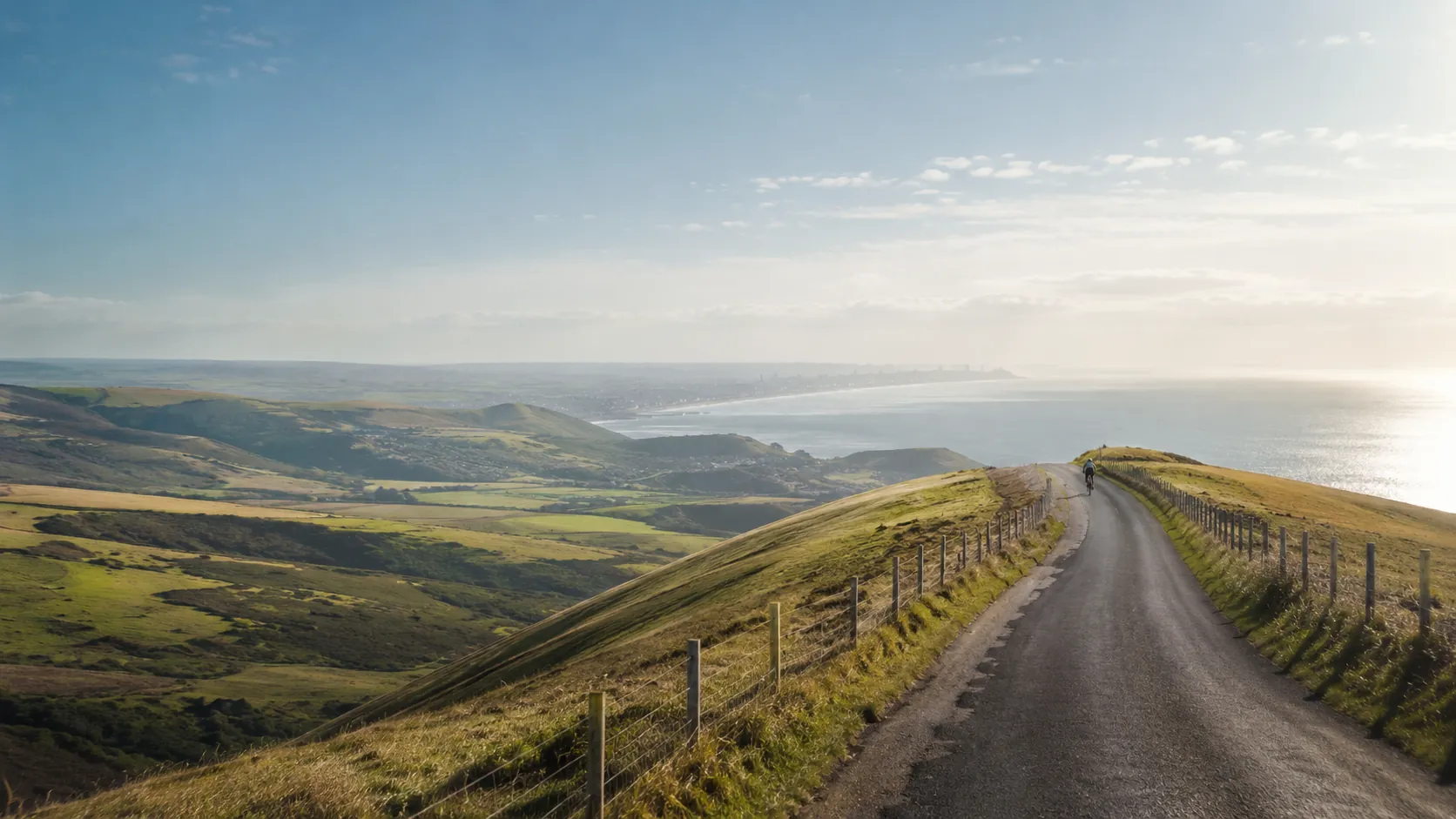
One of Britain's best-loved rides, made virtual. London to Brighton runs about 90 km (roughly 56 miles) from the capital, over the rolling North Downs and the famous Ditchling Beacon climb on the South Downs, down to the Brighton seafront. Route Rally turns every synced cycle, run or walk into progress along it, so you can take on this classic from wherever you train and watch your marker roll towards the sea.
Part of the Great British Routes series
- Route: London to Brighton
- Distance: 90 km
- Elevation gain: 987 m
- Short, classic seaside ride
- Best for: First rallies, short rallies of your own, and quick group wins
Planning your challenge
A cyclist averaging 150 km/week finishes inside a week of riding; runners at 40 km/week take a couple of weeks, and walkers around a month.
This is a Short route by Route Rally distance bands, so it is ideal for a first challenge or a quick goal a whole group can finish together.
Works well for newcomers, workplace teams, and as a warm-up before committing to a longer route.
Create your own rally for a quick personal target, solo or with a group for a shared leaderboard.
Why this route
- London to Brighton is one of the UK's most famous rides, a roughly 90 km (56 mile) run from the capital to the Sussex coast.
- As a virtual challenge you cover the distance in your own time, with no event day to enter and no need to ride it all at once.
- The short distance makes it a perfect first Route Rally goal, or a quick target for a club or office team.
- At a steady 150 km a week on the bike you would finish in days, while runners and walkers can take it on across a few weeks.
- It pairs the pull of a well-known route with a distance almost anyone can complete.
Highlights
- Set off from London, the traditional start of the classic ride
- Build distance over the North Downs and the Ditchling Beacon climb on the South Downs
- Finish on the Brighton seafront, one of the coast's best-known spots
- Take it on solo, or share it with a club, workplace team or group of friends
Places along the route
Every place below is measured onto the route line, so the distance shown is where you actually reach it.
Places are researched from published sources. The distances are measured rather than estimated: we find the point on the route's own recorded line that lies nearest the place, and give the distance along the route to that point.
London
0–11 km · 4 places
0 km (0 miles) · engineering
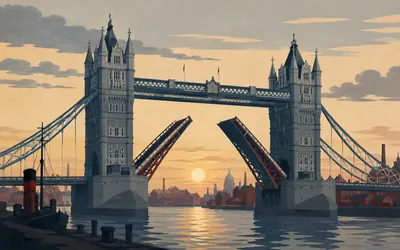
Tower Bridge
Mile zero, over the Thames
The road south starts on a bridge that opens.
- Tower Bridge opened in 1894 and its bascules still lift around 800 times a year.
- It is a bascule bridge in the middle and a suspension bridge at both ends.
- City Bridge Foundation maintains it at no cost to the taxpayer.
5 km (3 miles) · landmark
The Oval
Where English Test cricket started
A gasholder, a flat expanse of grass, and a ground that got there first at almost everything. The first FA Cup final was played here in 1872 and the first Test match on English soil in 1880. The Duchy of Cornwall has owned the land since the fourteenth century.
8 km (5 miles) · landmark
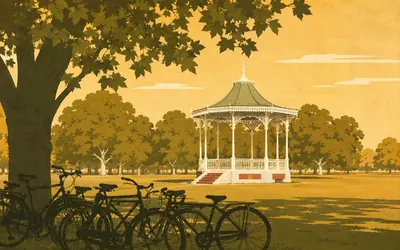
Clapham Common
Where the ride traditionally begins
Eighty-five hectares of flat grass, three ponds and a bandstand, and on one Sunday every June several thousand bicycles.
- The Metropolitan Board of Works bought Clapham Common in 1877 and made it a Metropolitan Common.
- It covers over 85 hectares, around 210 acres.
- The British Heart Foundation's London to Brighton Bike Ride starts here.
11 km (7 miles) · landmark
Tooting Bec Lido
Ninety-one metres of cold water
Opened in 1906 and still unheated, this is the largest freshwater outdoor pool in the UK: ninety-one metres of it, edged by a long row of brightly painted changing cubicles. People swim here right through the winter, which says something about them and something about south London.
Surrey
15–47 km · 8 places
15 km (10 miles) · heritage
Mitcham Cricket Green
Cricket here since at least 1685
The road runs straight past the boundary, which is how it has always been. Cricket has been played on this green since at least 1685, and the club says there is good evidence it is the oldest continuously used cricket ground in the world. Nobody has moved the pitch to settle the argument.
20 km (12 miles) · nature
Carshalton Ponds
Where the Wandle comes out of the chalk
Spring water rising straight out of the chalk in the middle of a village, and one of the two historic sources of the River Wandle. The spring beside them is called Anne Boleyn's Well; by tradition it rose where her horse's hoof struck the ground, though the name may just as easily be a worn-down local surname.
22 km (14 miles) · heritage
Oaks Park
Two of the world's great races, named here
The 12th Earl of Derby leased a house on this hill called The Oaks. The race he founded in 1779 took the house's name; the one he founded the year after took his own, and by tradition the choice between Derby and Bunbury was settled with a coin. The house is long gone. Both races are still run.
28 km (17 miles) · heritage
St Margaret's, Chipstead
Norman work at the top of the Downs
The church stands near the crest of the North Downs with twelfth and thirteenth century fabric still in it, including a Norman doorway in the north aisle. It was extended in the nineteenth century and restored by Norman Shaw in 1885. Grade I listed, and a decent excuse to stop climbing.
32 km (20 miles) · heritage
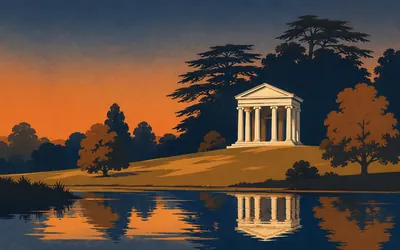
Gatton Park
Two MPs, almost no voters
A Capability Brown landscape on the dip slope of the North Downs, and one of the more shameless arrangements in English political history.
- Gatton returned two MPs to Parliament until the Reform Act of 1832, on a handful of voters.
- Lancelot 'Capability' Brown landscaped the park in the 1760s.
- The Town Hall folly of 1765 was built for the election ceremony.
35 km (22 miles) · heritage
Merstham
Where the iron plateway ended
Horse-drawn wagons on iron plateways reached Merstham in 1805, on the extension of the Surrey Iron Railway: a company with its own Act of Parliament, no canal behind it and no passengers, and believed to be the first fully independent public railway in the world. What it carried was stone. Merstham quarries had already supplied Old London Bridge and Windsor Castle.
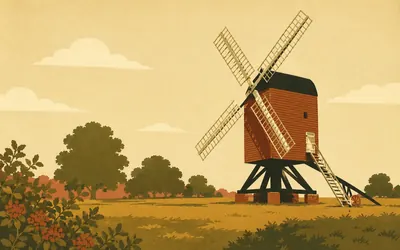
43 km (27 miles) · heritage
Outwood Windmill
Built in 1665 and still turning
A post mill on a Surrey common: the entire body of the mill pivots on one great upright post, so the sails can be swung round into the wind by hand.
- Outwood post mill was built in 1665 and is reputed to be the oldest working windmill in the country.
- It is Grade I listed, the highest of the three listing grades.
- A post mill turns its whole body on a single upright post to face the wind.
47 km (29 miles) · heritage
St Bartholomew's, Burstow
The first Astronomer Royal is buried here
A timber-framed bell tower with oak posts carrying the whole weight of it, and in the chancel the grave of John Flamsteed. He was the first Astronomer Royal, spent four decades cataloguing the stars from Greenwich, and was rector of this parish from 1684 until he died in 1719.
The Weald
55–67 km · 5 places
55 km (34 miles) · viewpoint
Turners Hill
Both sets of Downs from one ridge
The village sits at around five hundred and eighty feet on a High Weald sandstone ridge, one of the higher points of the Sussex Weald. On a clear day the North Downs are behind you and the South Downs are ahead, which is the whole ride in a single look.
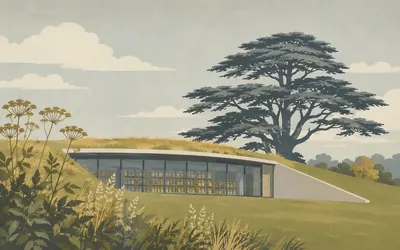
60 km (37 miles) · nature
Wakehurst
Kew's seed bank in the Sussex Weald
An Elizabethan house, a botanic garden spread across several hundred acres of Weald, and underneath it a vault of frozen seeds.
- The Millennium Seed Bank opened in 2000 and holds seeds from over 40,000 wild plant species.
- It holds the Guinness World Record as the largest seed bank in the world.
- Seeds are dried and stored underground at minus 20 degrees Celsius.
63 km (39 miles) · nature
Ardingly Reservoir
A drowned Wealden valley
Built through the early 1970s and completed by 1978, the reservoir holds nearly five thousand million litres across a hundred and eighty acres of what used to be a wooded valley. South East Water runs it. Sailing boats, herons, and a shoreline that changes shape every summer.
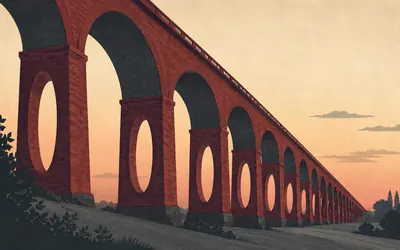
65 km (40 miles) · engineering
Ouse Valley Viaduct
Near this stage, eleven million bricks over a valley
Two miles west of the road, thirty-seven arches march across the Ouse valley: a quarter of a mile of brickwork ninety-six feet up, built in two years for a railway that had not yet proved it would pay.
- The viaduct opened in 1841 and carries 37 arches about 96 feet above the valley floor.
- Roughly 11 million bricks went into it.
- It is Grade II* listed; the pavilions and balustrade are by the architect David Mocatta.
67 km (42 miles) · heritage
Haywards Heath
The town the railway made
The town council's own history records that the London to Brighton line of 1841 was meant to bypass the place, and that local lobbying led to a station being built instead. The small agricultural village that stood here grew into a market town around it, and the heath it was named for is still on the maps.
The South Downs and Brighton
77–90 km · 6 places
77 km (48 miles) · heritage
Ditchling
A village that made things
Eric Gill moved here in 1907, and by 1921 there was a Guild of St Joseph and St Dominic: letter-cutters, printers, weavers and calligraphers all working at the foot of the Downs. The museum in the old school holds what they made. By tradition the village was once a royal manor of Alfred the Great.
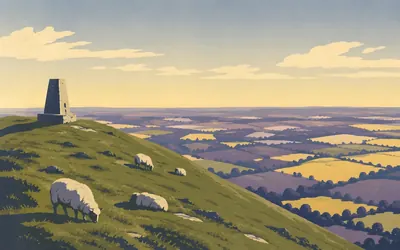
80 km (50 miles) · viewpoint
Ditchling Beacon
The last climb, and all of Sussex behind you
Two hundred and forty-eight metres, the highest point in East Sussex, and the climb every London to Brighton rider has an opinion about.
- At 248 m, Ditchling Beacon is the highest point in East Sussex.
- An Iron Age hillfort on the summit is a scheduled monument.
- Sussex Wildlife Trust manages the nature reserve on the Beacon.
82 km (51 miles) · heritage
Jack and Jill Windmills
Near this stage, a black mill and a white one
A mile and a half west along the scarp, a white post mill and a black brick tower mill stand side by side above Clayton. Jill was hauled up here from Brighton around 1850, by tradition behind teams of oxen; Jack was built in 1866. They share one Grade II* listing, and Jill is still a working mill.
86 km (53 miles) · heritage
Hollingbury Camp
An Iron Age fort on a golf course
A ring of bank and ditch on the hilltop, thrown up in the early sixth century BC on ground that had already been enclosed once before. It is a scheduled monument, and it is also, unavoidably, part of a municipal golf course. Brighton is laid out below it.
88 km (54 miles) · landmark
Preston Park Velodrome
The oldest cycle track in the country
The British Army dug this track out by hand in 1877 and racing began the year after. The city council calls it the oldest cycle track in the country, and it is still raced on. Preston Park around it, sixty-three acres of it, opened in 1884.
90 km (56 miles) · landmark
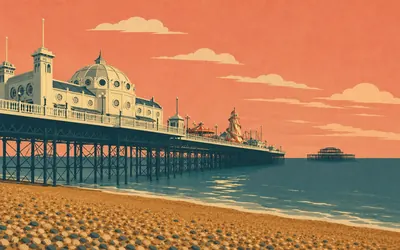
Brighton Palace Pier
The end of the road, out over the water
The road runs out and the pier carries on, a third of a mile of it, over water that is never quite the colour anybody expects.
- Brighton Palace Pier opened in 1899 and is Grade II* listed.
- It was Brighton's third pier, after the Chain Pier of 1823 and the West Pier of 1866.
- A storm destroyed the Chain Pier in December 1896.
Take on London to Brighton and collect these places as you reach them
Common questions
How does my riding count towards Brighton?
Nothing needs doing after the ride itself. With Strava or Apple Health linked, whatever you record rolls your marker south towards the seafront. On a route this short the maths is quick: a rider covering 150 km a week is at the coast inside a week, and many finish the distance across a single weekend.
Do I have to ride the real London to Brighton route?
No. The classic ride is a distance target here, not a course you have to follow, so laps of your local roads count exactly as much as the run over the North Downs. You will miss Ditchling Beacon, which some riders regard as the entire point of the day and others as the reason they drive.
How far is London to Brighton?
The Route Rally route covers about 90 km, or roughly 56 miles, London to the Brighton seafront. The classic real-world ride is a similar distance, which is part of why it is such a popular one-day goal.
How long does it take to cycle?
At a steady 150 km a week it is done in well under a week of riding, and many cyclists finish the distance in a single weekend. A more relaxed 75 km a week stretches it to a week and a half. You name the finish date at setup, so the schedule is yours.
Can I run or walk it instead?
Yes. The same route works as a running or walking target. Runners covering 40 km a week finish in a couple of weeks, while walkers building 30 km a week arrive in around a month. Every activity you sync counts.
Is this a good first virtual challenge?
It is one of the best. The distance is short enough to finish quickly, so you get a satisfying, recognisable win before stepping up to a longer route like LEJOG.
Start your London to Brighton Conquest
Joining is free. Connect Strava or Apple Health once and every ride, run or walk you record syncs automatically, moving you along the route without anything else to log.