Conquer the Virtual King Alfred's Way Challenge
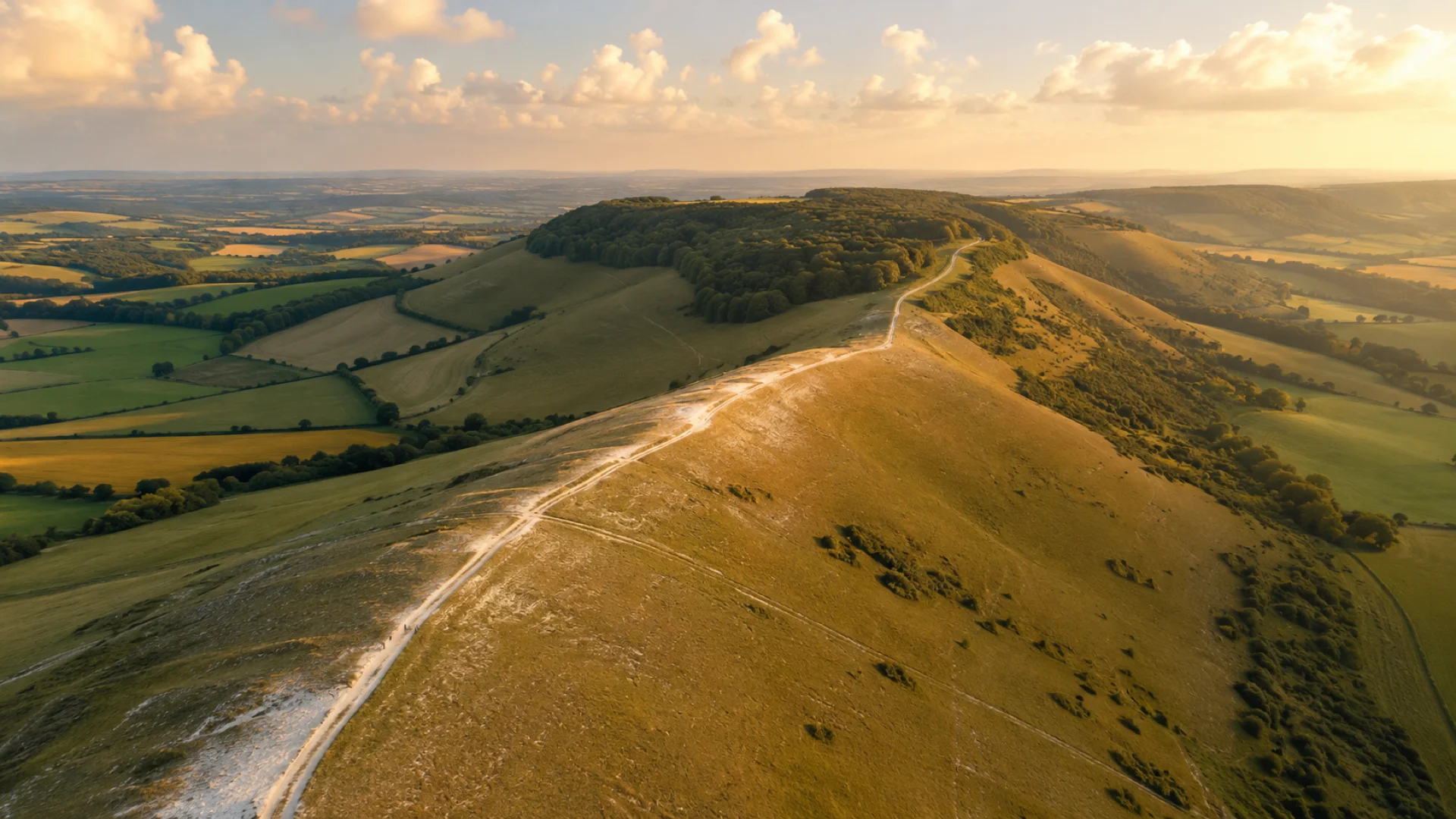
Follow this historic southern England route virtually. Route Rally converts synced distance into visible progress around the King Alfred's Way loop.
Part of the Great British Routes series
- Route: King Alfred’s Way
- Distance: 351 km
- Elevation gain: 4488 m
- Approachable historic loop
- Best for: First route rallies, shorter rallies of your own, and seasonal targets
Planning your challenge
A runner averaging 40 km/week could complete it in about 9 weeks; a cyclist at 150 km/week could finish in two to three weeks.
This is a Medium route by Route Rally distance bands, so it works when LEJOG feels too large but you still want a meaningful route goal.
Useful for a first rally, or a shorter route before committing to a longer one.
Create your own rally for your own challenge format, solo or with a club, workplace or group of friends.
Why this route
- King Alfred's Way is a compact historic loop through southern England.
- Compared with LEJOG, the shorter distance makes it easier to use as a first challenge or a focused monthly goal.
- The loop format gives the route a satisfying sense of completion for your own rally, solo or with a group.
Highlights
- Follow a loop inspired by historic southern England
- Use the distance as a manageable first virtual route target
- Build progress towards a complete loop rather than a one-way finish
Places along the route
Every place below is measured onto the route line, so the distance shown is where you actually reach it.
Places are researched from published sources. The distances are measured rather than estimated: we find the point on the route's own recorded line that lies nearest the place, and give the distance along the route to that point.
Winchester and the Test
0–22 km · 8 places
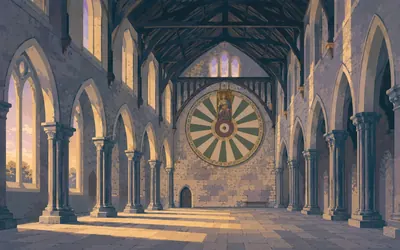
0 km (0 miles) · heritage
The Great Hall, Winchester
Kilometre zero, under a round table
All that is left of Winchester Castle is its hall, built by Henry III, and hung on the west wall inside it is a great painted disc that the listing record calls, without further comment, a medieval Round Table.
- The Great Hall is the only surviving part of Winchester Castle and was built under Henry III.
- Cycling UK launched King Alfred's Way on 28 August 2020; it was devised by Kieran Foster.
- Cycling UK describes it as a 350km circular off-road route through 10,000 years of history.
0 km (0 miles) · heritage
Hyde Abbey Gateway
A gate, and an argument about bones
A stone gateway standing on its own in a suburb. Behind it stood Hyde Abbey, founded in 1110, to which the bones of Alfred, his wife and his son were moved from the old minster. The abbey was surrendered at the dissolution in 1538; a prison was built over the site in 1788; and where Alfred is now has been argued about ever since. Nobody has proved anything.
8 km (5 miles) · landmark
Farley Mount
A pyramid for a horse
A stone pyramid ten metres high on top of a Bronze Age barrow, put up in 1795 by Sir Paulet St John of Farley Chamberlayne. The listing gives the reason without embarrassment: it commemorates a favourite hunter which leapt into an eight-metre chalk pit without injury to horse or rider.
13 km (8 miles) · heritage
King's Somborne
A royal manor and a deer park
A Test valley village that was Crown land at Domesday, which is where the King in its name comes from. The earthwork bank of a medieval deer park survives around it as a scheduled monument, associated with John of Gaunt; tradition puts his house behind the church, though nothing on the register says so.

14 km (9 miles) · nature
The River Test at Horsebridge
A chalk stream you can read the bottom of
The Test comes out of the chalk rather than off it.
- Natural England calls the Test a classic chalk stream and one of the most species-rich lowland rivers in England.
- Chalk streams are spring-fed, so their temperature barely varies through the year.
- The SSSI covers about 50 km of river and 442.93 hectares.
17 km (11 miles) · heritage
The Drovers House, Stockbridge
An advertisement in Welsh
Painted on the front of a house on the main street, in Welsh: seasoned hay, tasty pasture, good ale, comfortable beds. Welsh drovers brought cattle across England on the hoof for centuries and Stockbridge was a stop on the road. The sign was aimed at customers who could not read English.
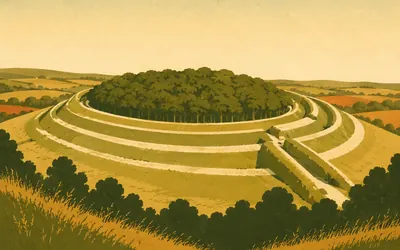
20 km (12 miles) · heritage
Danebury
An Iron Age town, dug for twenty years
A ring of banks and ditches on a chalk hill with a beech hanger inside it, and one of the most thoroughly investigated Iron Age sites in the country.
- Danebury was excavated between 1969 and 1988 under Barry Cunliffe.
- Excavation found round houses, streets, raised granaries and thousands of storage pits.
- Historic England's scheduling record for Danebury is a legacy entry with no description text.
22 km (13 miles) · heritage
Nether Wallop
Angels found under the limewash
St Andrew's has three layers of wall painting on three walls. The listing dates the east wall's flying angels, holding an almond-shaped frame around Christ, to the eleventh century; there are Sabbath-breakers on the south wall from the fourteenth and a painted bell on the west from the sixteenth or seventeenth. All of it spent centuries under whitewash.
Salisbury Plain
35–90 km · 8 places
35 km (22 miles) · heritage
Figsbury Ring
A ditch nobody can date
A ring of bank and ditch on a chalk spur, and inside it a second ditch with no bank, which is not how hillforts work. Historic England has been arguing with itself about that inner ditch for decades and says so: a geophysical survey in 2004 did not settle it, and the register lists the site as a henge and a hillfort at once.
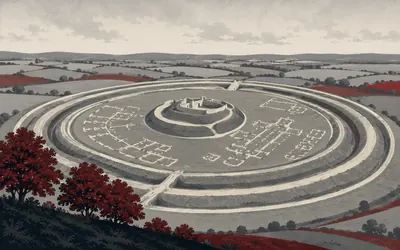
40 km (25 miles) · heritage
Old Sarum
The city that walked downhill
An enormous circular earthwork with a castle mound inside it and the footings of a cathedral in the outer ring.
- William the Conqueror's castle was built inside the earthwork in 1069.
- The cathedral moved down to New Sarum, now Salisbury, in the 1220s.
- Old Sarum went on electing two MPs until the Reform Act of 1832.
51 km (32 miles) · heritage
Vespasian's Camp
Named after a Roman who was never here
A long wooded hillfort above the Avon at Amesbury, which Historic England calls the only Iron Age fortification in the immediate Stonehenge area. It was built around 500 BC and again around 400 BC, with little sign of anyone using it afterwards. An antiquary attached Vespasian's name to it; the archaeology gives him nothing to stand on.
54 km (34 miles) · heritage
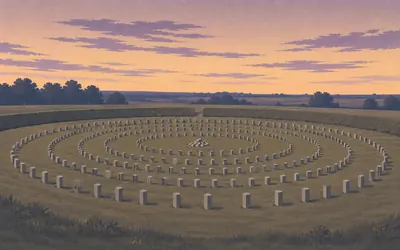
Woodhenge
Six rings of posts, seen from an aeroplane
In 1925 Squadron Leader Gilbert Insall was flying over Durrington when he noticed rings of dark spots in a wheat field.
- Woodhenge was found from the air in 1925 by Squadron Leader Gilbert Insall.
- The timber postholes are now marked with concrete posts.
- Historic England calls neighbouring Durrington Walls one of the largest henge monuments known.

56 km (35 miles) · landmark
Stonehenge
Stone that travelled further than you have
You come at it along a byway from the north, over the Cursus, and it appears sideways on with the traffic behind it.
- English Heritage says the sarsens most likely came from West Woods on the Marlborough Downs.
- The bluestones all came from the Preseli Hills in south-west Wales.
- A 2024 study reattributed the Altar Stone to north-east Scotland, roughly 700 km away.
61 km (38 miles) · heritage
Robin Hood's Ball
Older than Stonehenge, inside a range
A Neolithic causewayed enclosure of two broken ditch rings, older than any of the stones down the road, sitting inside the Army's training area. Historic England notes it is the only one recorded on the whole of Salisbury Plain. Whether you can get near it depends on the red flags.
71 km (44 miles) · heritage
White Barrow
A Neolithic mound nobody has opened
A long barrow lying right beside the track, unexcavated, with its original profile still largely intact apart from some badger work. Natural England's citation for the Plain records it as National Trust land: a small green island of protection in the middle of a firing range.
90 km (56 miles) · nature
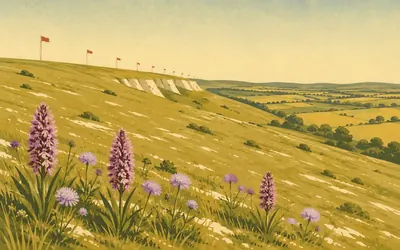
Salisbury Plain
Saved from the plough by the Army
Nearly twenty thousand hectares of it are notified as a Site of Special Scientific Interest, and Natural England puts the significance in one sentence: Salisbury Plain supports the largest known expanse of unimproved chalk downland in north-west Europe, and represents forty-one per cent of Britain's remaining area of that habitat.
- Natural England calls Salisbury Plain the largest known expanse of unimproved chalk downland in north-west Europe.
- The same sentence puts it at 41% of Britain's remaining area of that habitat.
- The SSSI covers 19,689.91 hectares and was confirmed in January 1993.
Avebury and the Marlborough Downs
102–108 km · 4 places
102 km (63 miles) · heritage
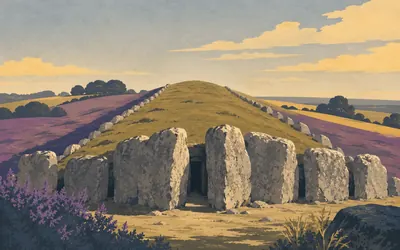
West Kennet Long Barrow
A tomb closed with a false door
A hundred metres of turf-covered mound on a ridge, with a row of enormous sarsens standing across the eastern end and a stone passage running back into the dark behind them.
- English Heritage dates the barrow to around 3650 BC and says it stayed in use for at least a thousand years.
- It was excavated scientifically in 1955-6 and the eastern chambers were then reconstructed.
- When the tomb was closed, a false entrance of twin sarsen uprights was built across the front.

104 km (65 miles) · landmark
Silbury Hill
Half a million tonnes, and no idea why
A flat-topped cone of chalk thirty metres high and a hundred and sixty across, sitting in a valley bottom where you would least expect a hill.
- English Heritage calls Silbury Hill the largest artificial prehistoric mound in Europe.
- It is 30 metres high and 160 metres wide and holds about half a million tonnes of material.
- A shaft sunk from the summit in 1776 collapsed in May 2000, opening a 14-metre crater.
106 km (66 miles) · heritage
The Sanctuary
Concrete standing in for stone
A field of small concrete blocks and posts on Overton Hill, each one marking where a timber upright or a standing stone used to be. English Heritage puts the beginning at about 2500 BC. An excavation in 1930 found the plan, and a Bronze Age grave: a teenage boy buried with a small Beaker pot.
108 km (67 miles) · nature
Fyfield Down
A valley full of loose stone sheep
Hundreds of grey sarsen boulders lying across the grass in the bottoms of dry valleys, left where the frost dropped them. Natural England calls this the best assemblage of sarsen stones in Britain. Locally they have always been the grey wethers, because from a distance they look like a flock of sheep. Stonehenge is built of their cousins.
The Ridgeway scarp, given to the Ridgeway
136 km · 1 place

136 km (84 miles) · heritage
Alfred's Castle
The king's name, and nothing else of his
A small polygonal hillfort of a single bank and ditch, up on the down above Ashdown House.
- Historic England's scheduling record for Alfred's Castle never mentions King Alfred.
- Excavation dated the enclosure from the 6th century BC, with a Roman-period farmhouse inside it later.
- The site of the Battle of Ashdown, fought in 871, has never been established.
The Thames and Reading
175–192 km · 5 places
175 km (109 miles) · engineering
Gatehampton Viaduct
Brunel, on a quiet day
Four shallow elliptical arches carrying the Great Western over the Thames, designed by Brunel himself and built between 1838 and 1840, with a second viaduct added alongside in the 1890s. The listing is refreshingly frank that the Goring Gap did not demand the daring of Maidenhead. It is still Brunel, and it is still beautiful brickwork.
177 km (110 miles) · heritage
Basildon Park
Palladian, in Bath stone, in Berkshire
A golden Palladian house of 1776-83 by John Carr of York, built for Sir Francis Sykes on a terrace above the Thames and altered by J. B. Papworth in the 1840s. Historic England calls it a very complete and important example of a Carr house, which for the register is warm praise.
179 km (111 miles) · engineering
Whitchurch Bridge
Privately owned since 1792
A four-span steel bridge of about 1900 between Pangbourne and Whitchurch, and an unusual survival: it belongs to a company of proprietors who have owned the crossing since an Act of Parliament of 1792 and are obliged by statute to keep it in repair for ever. It is a toll bridge, and has been one for as long as it has existed.
191 km (119 miles) · heritage
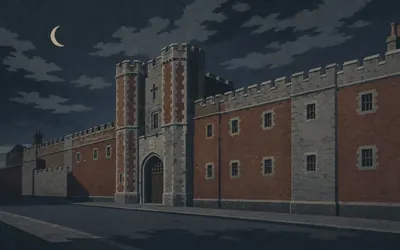
Reading Gaol
The separate system, and a poem
A castellated brick prison of 1842-4 by George Gilbert Scott and William Moffatt, which Historic England calls an impressive, fortress-like design and a pioneering English example of a radial-plan prison built for the separate system.
- Historic England calls it a pioneering English example of a radial-plan prison built for the separate system.
- Oscar Wilde was held here from November 1895 to May 1897 and published his ballad in 1898.
- The prison closed at the end of 2013 and the building was sold in January 2024.
192 km (119 miles) · heritage
The Maiwand Memorial
Sixteen tons of cast-iron lion
An enormous iron lion, three times life size, raised by public subscription in 1886 in the gardens beside the abbey. Its plinth carries the names of eleven officers and three hundred and eighteen men of the 66th Berkshire Regiment killed at Girishk, Maiwand and Kandahar in 1879 and 1880. A county regiment, and a county's worth of names on one plinth.
North Hampshire and Farnham
205–269 km · 13 places
205 km (128 miles) · heritage
Swallowfield Park
A doorway moved out of the way
A late-seventeenth-century house built by William Talman for the second Earl of Clarendon and made over in 1820 by William Atkinson. Talman's stone garden doorway survived the rebuilding and is listed separately; the oval vestibule inside is, the register says carefully, said to be part of his work too.
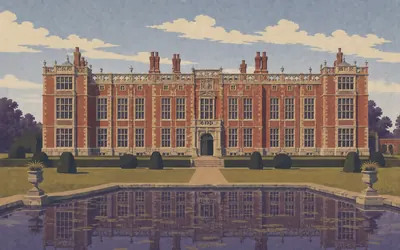
214 km (133 miles) · heritage
Bramshill
A Jacobean palace and a water garden
A vast red-brick Jacobean house built between 1605 and 1612, three storeys on its south front and two on the others, with a pierced stone balustrade running along the top of it.
- Historic England dates the house 1605-1612 and lists it Grade I.
- Its early 17th-century water garden is described as an exceptional, probably unique survival.
- It is one of only three English houses built with separate state apartments for a king and a queen.
220 km (137 miles) · nature
Hazeley Heath
Notified for being ordinary, at scale
Natural England is unusually candid about this one: though it possesses no unique features, the site is notified because it is a relatively large tract of heathland, and heathland is now nationally scarce. A hundred and seventy-seven hectares of gorse, heather and birch scrub, part of the Thames Basin Heaths protected for nightjar, woodlark and Dartford warbler.
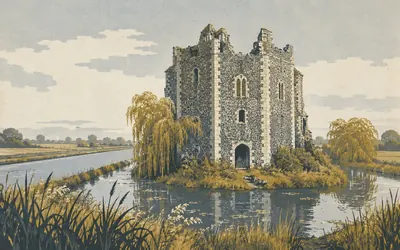
226 km (140 miles) · heritage
Odiham Castle
King John's, probably
A shattered flint octagon standing in wet meadow beside the Basingstoke Canal, with the moat still holding water round it.
- Historic England's listing hedges the keep as said to be King John's; its scheduling dates it 1207-1212.
- A French force besieged the castle for two weeks in 1216, soon after it was finished.
- The ruin stands on the bank of the Basingstoke Canal, which was cut past it in the 1790s.
237 km (147 miles) · heritage
Crondall
A brick tower stuck on a Norman church
All Saints is mostly work from either side of 1200, with a startling addition: the central tower was taken down in 1657 and replaced by an enormous red brick one built onto the side of the chancel in medieval shapes. The listing adds a restoration by Sir George Gilbert Scott in 1871.
243 km (151 miles) · heritage
Farnham Park
The bishop's deer, and then everyone's
Three hundred acres of old parkland on the edge of the town, laid out as a deer park for the Bishops of Winchester; William of Wykeham made the New or Little Park here in 1376. The register notes, with its own date attached, that it passed into public hands. The oaks are the giveaway: park trees, grown in the open.
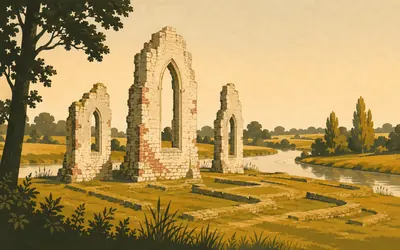
249 km (155 miles) · heritage
Waverley Abbey
Where the Cistercians landed
A few tall fragments of wall standing in a meadow in a loop of the Wey, and the beginning of something enormous.
- English Heritage calls Waverley the first Cistercian house to be established in Britain.
- It was founded in 1128 by William Giffard, Bishop of Winchester, with monks from Aumône.
- The abbey flooded in 1201; the replacement church took from 1203 to 1278 to finish.
251 km (156 miles) · engineering
Tilford Bridge
Two medieval crossings, one green
Tilford has two scheduled medieval bridges over the Wey, one at each end of its green, both narrow, both humped, both still carrying traffic they were never built for. The green between them has a very large old oak on it.

255 km (159 miles) · nature
Frensham Common
Two ponds that were once a larder
Sandy heath, pine, gorse and two large sheets of open water, and the water is the surprise: the Great and Little Ponds are not natural.
- The Great and Little Ponds were dug in the 13th century as fish ponds for the Bishop of Winchester.
- Both ponds were drained in the Second World War so they could not guide enemy aircraft.
- Lowland heath like this is now scarcer across Europe than tropical rainforest is worldwide.
261 km (162 miles) · heritage
The Atlantic Wall, Hankley Common
A hundred metres of practice
A slab of reinforced concrete a hundred metres long and three and a half thick, lying across the heath, built in 1943 as a full-size replica of the German coastal defences so that engineers could work out how to breach them. It is scarred where they did. It carries no heritage designation at all; the Ministry of Defence simply keeps it.
263 km (163 miles) · nature
Thursley Common
Bog, boardwalk and dragonflies
A National Nature Reserve of wet and dry heath with a boardwalk across the bog, carrying five designations and famous among entomologists for its dragonflies. Sand lizards and smooth snakes are among the reasons it is designated.
269 km (167 miles) · heritage
Gibbet Hill
A stone, a cross, and a man with no name
In September 1786 a sailor walking to Portsmouth was robbed and killed on this hill by three men he had bought drinks for. They were caught, and the following April they were hanged in chains here, in sight of the road. Nobody ever established who he was. A stone was put up in 1787 and a granite cross in 1851.
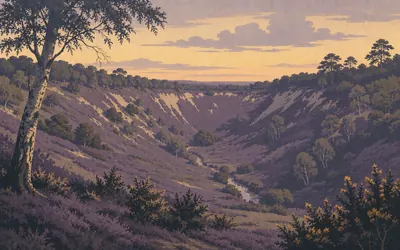
269 km (167 miles) · nature
The Devil's Punch Bowl
A road taken out of a view
An enormous natural amphitheatre bitten out of the greensand, believed to have been carved by springs undercutting the rock until the slopes above collapsed.
- The Hindhead Tunnel is 1,830 metres long and opened in July 2011.
- National Highways describes it as one of the longest road tunnels in the UK.
- The old A3 over the rim of the Punch Bowl was removed and the heathland restored.
The western Weald and the Meon
284–351 km · 13 places
284 km (176 miles) · landmark
Longmoor
Red flags and Bronze Age barrows
A live firing range with a scatter of scheduled Bronze Age disc barrows inside it. The Army has been here since 1903 and once ran its own railway across the heath to teach sappers how to build and work one; that closed in 1969. Watch for the flags and stay on the right of way.
289 km (179 miles) · nature
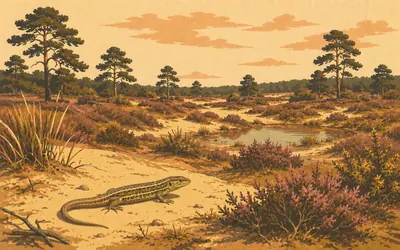
Woolmer Forest
All twelve of them, in one place
Britain has twelve native reptiles and amphibians: three snakes, three lizards, three newts, and frog, toad and natterjack.
- Natural England calls Woolmer the only site in Britain known to support all twelve native reptiles and amphibians.
- It is the only known British location of the water beetle Graphoderus zonatus.
- The citation names it the last native heathland site in Britain for the natterjack toad.
296 km (184 miles) · heritage
Petersfield Heath
A cemetery under the cricket pitch
The mounds scattered round the pond and the sports ground are a Bronze Age barrow cemetery, at least twenty-one of them by the local museum's count, dug and surveyed by a community project. One is a bell barrow, a form Historic England describes as the most visually impressive kind of round barrow, with fewer than two hundred and fifty known nationally.
302 km (187 miles) · heritage
Uppark
Burnt in 1989, put back again
A square red house of about 1689 on the very top of the downs, its design attributed to William Talman, with interiors of around 1770 that the listing record, written thirty years before the fire, calls hardly altered in any respect. H. G. Wells spent part of his boyhood below stairs here; his mother was the housekeeper.

308 km (192 miles) · heritage
Butser Ancient Farm
Archaeology you are allowed to burn down
Thatched roundhouses, a Roman villa and a Neolithic hall standing in a field, and none of them are a theme park.
- Butser started in 1972 on a trial site called Little Butser and held its first open day in 1974.
- Every building is based on evidence from a real excavation, from the Stone Age to the Anglo-Saxon period.
- It runs as a not-for-profit and works with UCL's Institute of Archaeology and Wessex Archaeology.
318 km (197 miles) · heritage
East Meon
A font shipped from Flanders
All Saints stands against the hill with a Norman tower, and inside it is a great square font of black Tournai marble carved with Adam and Eve and a rather smug serpent. Seven of these survive in England and four are in Hampshire; this bishop's county got the pick of them. Historic England says only that the church is famous for it.
324 km (202 miles) · heritage
King John's House, Warnford
A name the register will not explain
Two tall walls and a row of column bases standing in parkland beside the Church of Our Lady: the remains of a thirteenth-century aisled hall. It is scheduled as King John's House, or St John's House, and Historic England's record has nothing under summary, nothing under history and nothing under reasons. Even the register is only reporting what it is called.
327 km (203 miles) · heritage
Corhampton Church
Two rooms, and almost no changes
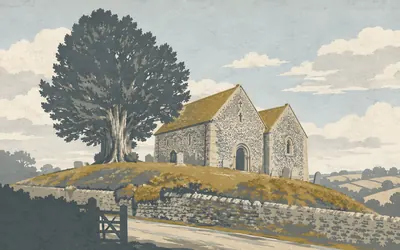
It has no dedication, no tower and, for a thousand-year-old building, remarkably little added to it.
- Historic England describes Corhampton as an almost complete two-cell Saxon church.
- It retains its original Saxon chancel arch.
- The east end was rebuilt in 1855 after it collapsed during roadworks.
330 km (205 miles) · heritage
Lomer
A village with no record left
You ride straight over it. Under the grass on either side of the track are the platforms and hollow ways of a medieval village that emptied and was never reoccupied. Historic England scheduled four and a quarter hectares of it as nationally important and has published nothing else at all: no date, no cause, no description.
347 km (216 miles) · heritage
Twyford Down
Roman fields under a motorway
Historic England's scheduling here describes a late Romano-British farmstead or villa with its lynchets and hollow ways, and separately notes another set of hollow ways, the Dongas, five hundred metres to the north-west. It says nothing about the motorway. The M3 cutting was driven through the down and opened in 1995.

349 km (217 miles) · heritage
St Catherine's Hill
A maze cut in the turf, twice
The hill above Winchester with a clump of beeches on the crown, and three thousand years of use underneath them.
- The hillfort dates from about 550 BC and encloses roughly nine hectares.
- A Norman chapel to St Catherine stood on the summit before the mid-12th century.
- Historic England says the turf mizmaze was cut between 1647 and 1710 and recut to a new pattern in the 1830s.
351 km (218 miles) · heritage
Wolvesey Castle
One bishop's very large idea
The ruins of the medieval bishops' palace, tucked behind the cathedral against the city wall. English Heritage credits almost all of it to one man, Henry of Blois, bishop from 1129 to 1171 and brother of a king. His audience chamber was twenty-seven metres long. Mary I and Philip of Spain held their wedding banquet here in July 1554.

351 km (218 miles) · landmark
The King Alfred Statue
Back where you started, three hundred and fifty kilometres later
Hamo Thornycroft's bronze Alfred stands at the bottom of the Broadway with his sword held up by the blade, so that it makes a cross.
- The statue is Hamo Thornycroft's, completed in 1901 for the millenary of Alfred's death.
- Alfred holds his sword by the blade so that it reads as a cross.
- Cycling UK's King Alfred's Way begins and ends at this statue.
Take on King Alfred’s Way and collect these places as you reach them
Common questions
How does my riding count towards King Alfred's Way?
Your rides count themselves. Anything Strava or Apple Health records, whether a ride, a run or a walk, is added to the loop with no input from you. Because King Alfred's Way is a circuit, your progress is measured as the share of the loop you have closed: at 150 km a week on the bike it closes in two to three weeks.
Do I have to ride in southern England to take it on?
No. The loop is a length to cover, not a place you have to stand, so laps of a local park or a turbo session count exactly as much as tracks in southern England. Route Rally only asks how far you have gone; the historic loop supplies the shape of the goal and the satisfaction of closing it.
Is this a good first virtual challenge?
Yes, that's exactly what it's built for. The distance is short enough to finish in a month or two of regular activity, so you get a satisfying win without committing your whole year.
Start your King Alfred’s Way Conquest
Joining is free. Connect Strava or Apple Health once and every ride, run or walk you record syncs automatically, moving you along the route without anything else to log.